 Wakeloom
To evaluate a Polymarket trader before you copy, you need a long enough period and enough markets that have actually resolved. Rule out wallets that made their money from one big bet, wash trading or market making, then look at how deep the rest drew down and how much they paid to get in. A leaderboard rank or one huge win tells you very little on its own. And past results don't predict future ones.
A PnL leaderboard only tells you so much
Most people start by opening a leaderboard sorted by profit and picking from the top. The people you find that way really did make money. Whether you can copy how they made it is another question.
Every Polymarket market ends with a single outcome. Put a very large position on one event, get it right, and your PnL jumps up the board. From one trade you can't tell how much was skill and how much was luck. Some leaderboards also mark open positions to the current price, so ranks move every time prices do.
Use a profit leaderboard to find names. Don't use it to reach conclusions. Can you just go by the #1 trader? Not necessarily; see the FAQ.
First, rule out three kinds of wallets you can't really copy
Wallets whose profit comes from one event. If most of a wallet's gains come from a single event, its record mostly reflects whether that one call landed. Your next copied trade is on a new event, and last time's luck doesn't carry over.
Wash-traded and self-matched wallets. Volume far out of line with profit, or trades against itself, suggests the volume and the rank may be manufactured. Little to learn from them.
Market makers. Wallets that quote both sides earn mostly from the spread. When you follow their direction you don't get their resting price, and your results end up much worse.
Wakeloom scores wallets against thresholds such as profit concentration and wash trading; wallets that fail get no overall score. Suspected market-maker addresses are not ranked. These checks are still being filled in, so whichever leaderboard you use, Wakeloom's included, check these three things yourself. Scoring details: How it works.
Then check whether the sample is big enough
The first thing to look at is sample size: how many resolved markets this person has traded. Resolved markets are counted over the wallet's full history, not just recent months.
With only a few resolved markets, win rate and ROI swing on one or two outcomes. Someone who traded a handful of markets and won them all has prettier numbers than someone with a few hundred markets and an average win rate, but the second record says more.
Mind the window too. On Wakeloom, win rate and ROI use the last 90 days, and wallets with too few trades don't get a detail page. If someone did well before that and has since changed style, it shows up in the window.
Read win rate together with entry price and drawdown
A high win rate is reassuring, but on Polymarket the price is roughly the market's probability. A share pays $1 if the outcome is true. Buy at 90¢ and a win earns 10¢ a share; a loss costs 90¢. Someone who always buys around 90¢ can have a very high win rate and still give back many wins with a single miss.
The reverse holds too: a trader who often buys cheap may win less than half the time and still come out fine.
So look at win rate alongside average entry price, plus max drawdown. Drawdown shows how bad the account looked at its worst. Copy that person and you'll probably live through something similar. The deeper the drawdown, the harder it is to stay in.
Ask whether you can actually keep up
Even if the numbers check out, ask: can you really follow?
You only place your order after you see theirs, so there's always a delay. In thin markets the price can move within minutes, and you pay more than they did. If they hold briefly and trade fast, the gap gets wider. More on this in Common pitfalls of copying the leaderboard.
Size positions against your own bankroll. A drawdown they can sit through may be too much for you at the same proportion.
Try it on paper first
Once you have a shortlist, the safer move is to keep real money out of it and paper-copy for a while. See what's left after spread, delay and fees.
Wakeloom currently offers paper-trading analysis only and is not live yet. Its paper trades fill against the live order book at the moment the leader's trade is seen and record the price gap to the leader. Results are for research only and are not investment advice.
How the Wakeloom leaderboard is ranked
The leaderboard is sorted by overall score (smart_score). Every page shows a data timestamp (as_of), and the website and the app read the same data, so the timestamps match. Win rate and ROI appear on the board for reference only; they don't set the order. Each wallet page shows last-90-day win rate, ROI, max drawdown, resolved-market count, average entry price and more. Values we can't get show "No data", never 0.
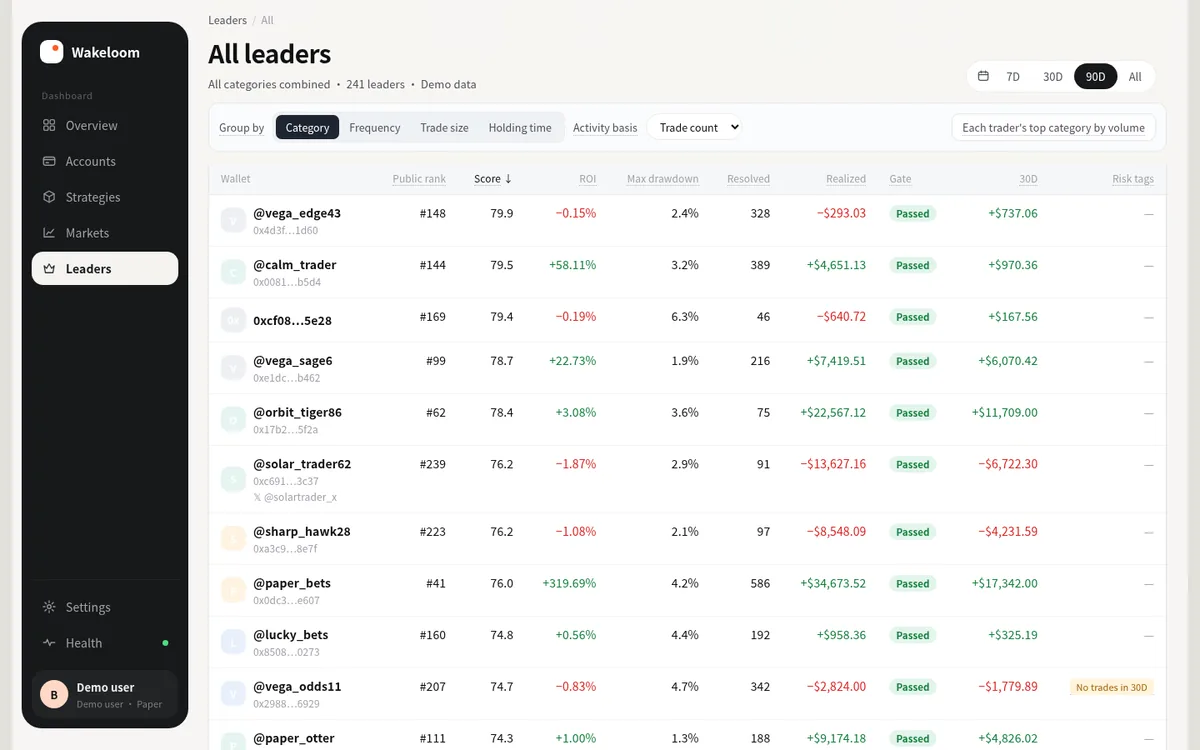
Being on the board means a wallet scored well in the window. It doesn't mean it will keep doing so. Traders change style, and they make mistakes.