 Wakeloom
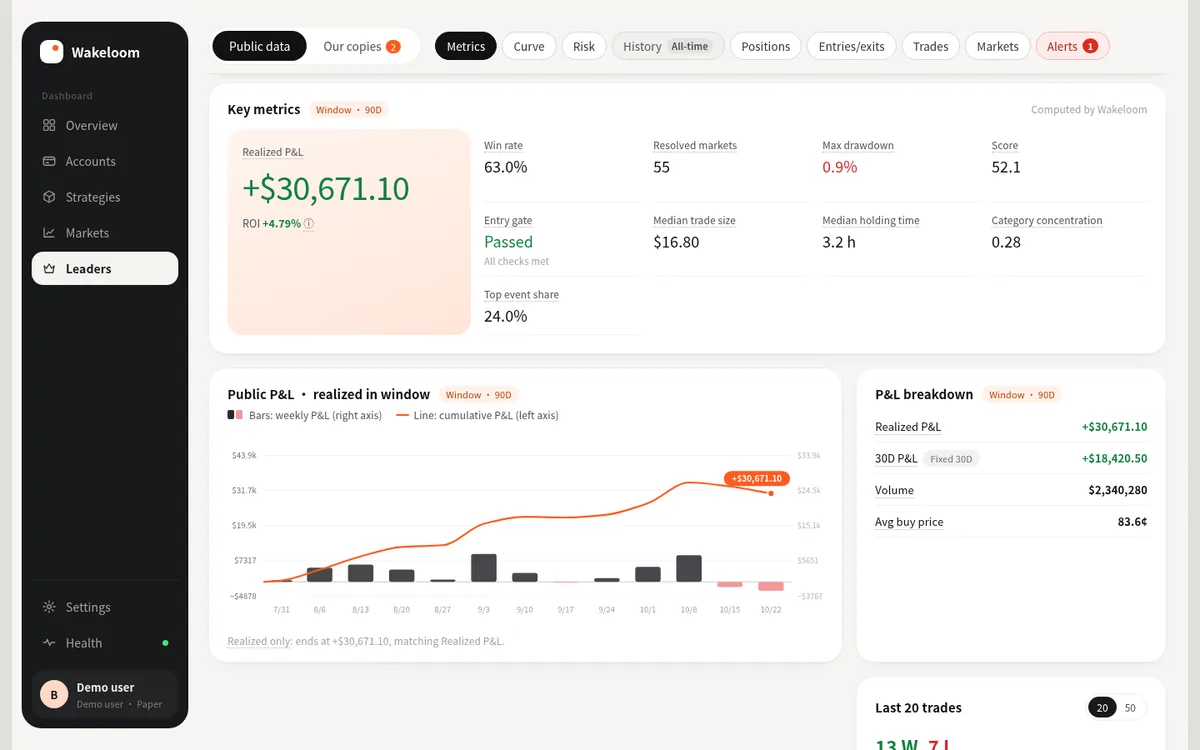
Before copying a Polymarket trader, check three numbers: how many resolved markets they have, how deep their max drawdown is, and whether their profit sits in one or two events. If those hold up, look at win rate next to average entry price, trade size and hold time, and finally confirm how fresh the data is. Here they are in that order.
Resolved markets: is the sample big enough?
Start here. This is the number of markets the wallet traded that have already settled. Wakeloom counts resolved markets over the wallet's full history.
Until a market resolves, its PnL is only a mark and moves with the price. Counting only resolved markets shows you results that are locked in.
The smaller the sample, the more one or two outcomes skew win rate and ROI. There's no universal "enough"; compare people on the same board. If two traders have similar ROI and one has several times more resolved markets, trust that one's numbers more.
Win rate and ROI on Wakeloom use the last 90 days. Wallets with too few trades don't get a detail page.
Max drawdown: could you sit through it?
Max drawdown is the deepest fall from a peak, as a percentage. It answers: what does the worst stretch look like if I follow this person?
Two traders with similar ROI: the one with smaller drawdown had a smoother ride. The other may still have ended up ahead after falling a long way. Copy them proportionally and your account takes a similar hit, and that's when many people quit, just before the recovery.
Ask yourself whether you'd accept that drop in your own account.
Profit concentration: what's left without the best event?
Most often skipped, and simple to do. How much of the wallet's profit comes from its single biggest trade or event? Remove it. Is the rest still positive?
If most of the profit comes from one event, the record mostly says that call was right. That's hard to repeat, and every trade you copy is on a new event.
Wakeloom scores wallets against thresholds such as profit concentration and wash trading; wallets that fail get no overall score, and suspected market-maker addresses are not ranked. These checks are still being filled in, so on any leaderboard, Wakeloom's included, it's worth running through them yourself.
Win rate and average entry price: only meaningful together
Win rate alone misleads. A Polymarket price is roughly the market's probability, and a share pays $1 (USDC) if the outcome is true. Buy at 90¢: a win makes 10¢, a loss costs 90¢. Buy at 30¢: a win makes 70¢, a loss costs 30¢.
High win rate with high entry prices can be erased by one miss. Low win rate with low entry prices can still be positive over time. Always read average entry price next to win rate. Which matters more, win rate or ROI? Neither on its own; read both with entry price and max drawdown. See the FAQ.
ROI: know how it's calculated
Sites calculate ROI differently. Some count only realized PnL, some mark open positions to market, and the denominator may be capital deployed or account balance.
When Wakeloom calculates ROI itself, it uses realized PnL ÷ capital deployed, excluding unrealized PnL on open positions. When comparing two wallets, make sure the numbers use the same method and the same timestamp.
Trade size and hold time: can you actually do the same?
Median trade size shows how big this person usually bets. Compare it with your bankroll to see what proportional copying means for you: too small to bother, or above your own limit.
Median hold time shows their pace. If they get in and out fast, the price may have moved by the time you follow, and your results drift further from theirs. Longer holders are less affected.
Data timestamp (as_of): don't decide on stale data
Every number needs a timestamp. A leaderboard rank and a wallet page from different timestamps can't be compared.
Wakeloom shows the data timestamp on the leaderboard and on every leader page, and the website and the app read the same data. Values we can't get show "No data", not 0. Treat "No data" as unknown, never as zero.
After the numbers
All of this describes the past. Traders change style or get things wrong, and future drawdowns may not stay in the old range.
The safer next step is to paper-copy for a while and see what's left after spread, delay and fees. Wakeloom is not live yet and offers paper-trading analysis only. Results are for research only and are not investment advice.